
Schluter Jolly & Quadec Metal Trim vs. Bullnose Tile Edges in Showers

Schluter anodized aluminum or stainless steel profiles (Jolly and Quadec) outperform traditional bullnose on modern rectified porcelain showers because 80%+ of European and domestic large-format porcelain lines lack matching factory bullnose, and exposed unglazed tile biscuits chip easily. Urban Design & Remodel (Utah DOPL #10146123-5501, (801) 440-1952) installs finish-matched metal profiles for $4.50 to $14.00 per linear foot versus $10 to $20 for custom stone bullnose.
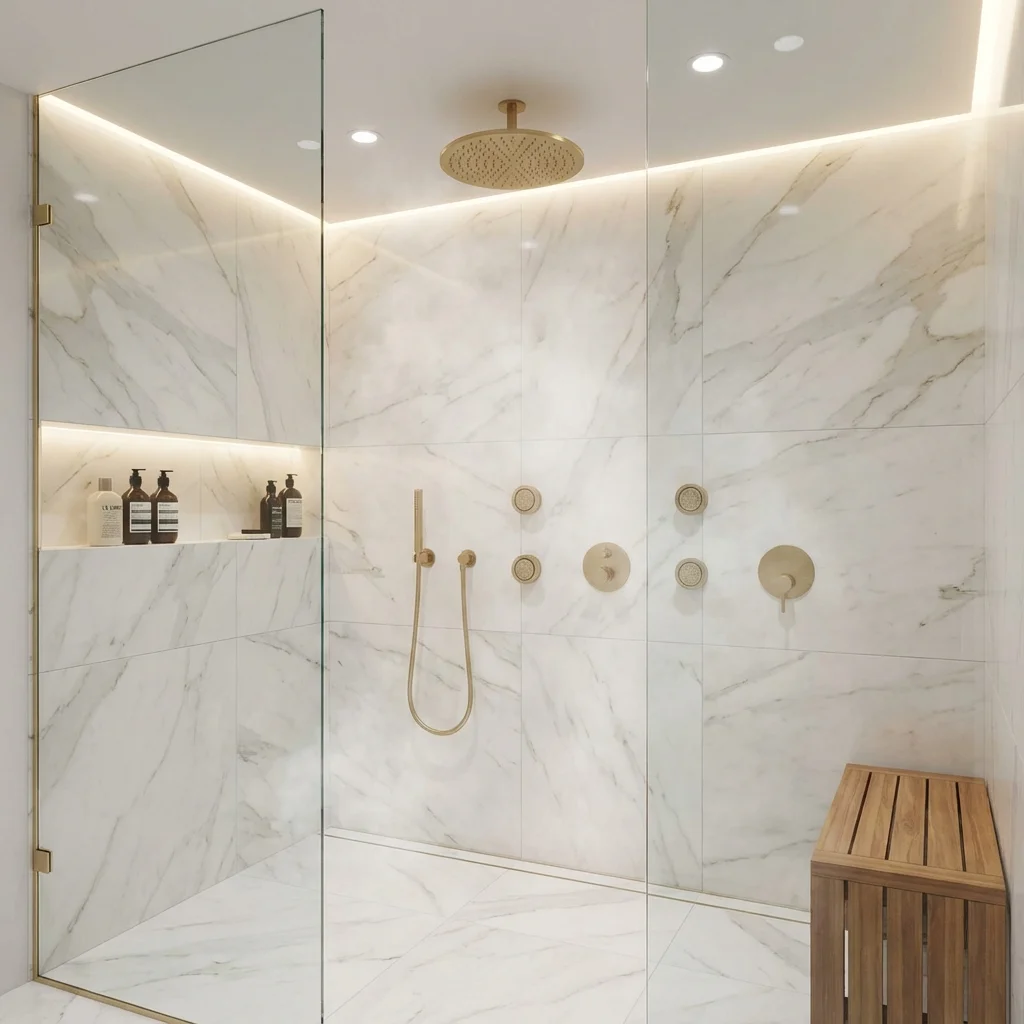
Every tiled shower has exposed outer transitions—along vertical shower screen walls, recessed shampoo niche perimeters, half-wall pony caps, and window jambs—where the raw biscuit edge of the porcelain must be cleanly protected. Twenty years ago, every ceramic line sold matching rounded 3x12 bullnose trim pieces. Today, over eighty percent of high-definition rectified Italian and domestic color-body porcelain collections omit rounded bullnose entirely, or offer mismatched pressed pieces with visible color shade shifts. Choosing between architectural Schluter metal edge profiles, custom-fabricated bullnose, or 45-degree mitered porcelain corners defines whether your Salt Lake County bathroom looks tailored or builder-grade.
Why Modern Rectified Porcelain Lines Rarely Include Matching Bullnose
High-definition inkjet-printed porcelain slabs are fired flat in large sheets and diamond-cut ('rectified') to razor-sharp 90-degree edges, leaving an unglazed clay or color-body biscuit along the side. Rounding and re-glazing that edge in a secondary kiln firing alters surface sheen and dye lot tones, which is why manufacturers either skip bullnose altogether or charge $9 to $16 per single 24-inch piece for mechanically ground-and-polished edges that still lack top-coat glaze protection. Leaving raw porcelain edges exposed or burying them in thick caulk invites chipping from glass squeegees and shampoo bottles. Extruded metal profiles embed directly into the thinset bed via a trapezoid-perforated anchoring leg, shielding tile corners permanently.
- Over 80% of 12x24 and 24x48 rectified porcelain lines have no factory kiln-glazed bullnose trim available
- Perforated anchoring legs lock metal profiles under the tile in thinset mortar so trim never pulls loose
- Integrated joint spacers inside Schluter profiles guarantee a uniform, straight 1/16"–1/8" grout line along edges
Schluter Jolly vs. Quadec vs. Rondec: Matching Architecture and Niches
Not all metal tile profiles look identical once grouted into place. Schluter Jolly features a minimalist 90-degree L-angle leg that shows only a razor-thin 1/8-inch metallic pinstripe along the outer face while exposing the full tile face—ideal for transitional and understated vertical wall terminations. However, when wrapping a three-dimensional recessed shower niche where horizontal and vertical trims intersect, cutting two flat Jolly strips at 45 degrees can leave sharp mitered points. Schluter Quadec (crisp 3/8-inch square-box edge) and Rondec (smooth symmetric radius) solve 3D outside corners cleanly using solid cast matching corner cubes that eliminate sharp metal miters around family tub ledges, benches, and shower niches.
- Schluter Jolly creates an ultra-slim 1/8" metallic reveal ideal for vertical shower wall terminations
- Schluter Quadec pairs square modern geometry with cast 3-way corner pieces for safe, seamless shower niches
- Profile depth must match tile + thinset thickness (typically 3/8" or 1/2" sizing for 9mm–10mm porcelain)
Coordinating Anodized Aluminum and 304 Stainless with Plumbing Trim
Early metal tile trims only came in shiny chrome or bright brass, which made design-focused homeowners hesitant to specify them. Today, architectural profiles come in satin nickel, brushed antique bronze, matte black, brushed warm brass, and color-coated Trendline textured finishes (matte white, greige, stone gray, and ivory) that disappear right into your porcelain color rather than matching your faucet. In Utah's 15+ GPG hard water zones, material chemistry matters inside wet showers: we specify solid brushed 304 stainless steel or high-grade anodized aluminum profiles cut cleanly on a high-tooth non-ferrous miter blade, strictly avoiding cheap PVC plastic bullnose strips that yellow and turn brittle within five years.
- Match Satin Nickel, Matte Black, or Brushed Brass profiles to PVD shower valves—or match tile tone with Trendline
- Specify 304 stainless steel on horizontal bench edges or curb corners subject to heavy abrasion and cleaning
- Never use alkaline bleach or abrasive scouring pads on anodized aluminum trims to preserve factory luster
45-Degree Mitered Porcelain Corners and Traditional Ceramic Bullnose
When is metal trim NOT the best architectural answer? In historic 1920s Sugar House, Avenues, or Yalecrest craftsman bungalows using handmade-look glazed ceramic subway tile—such as 3x6 or 4x12 Zellige-style clay—traditional kiln-glazed ceramic surface bullnose, cove base, or quarter-round pencil liners preserve authentic period warmth. Conversely, in ultra-luxury Holladay and Park City spa showers clad in 24x48 marble-look porcelain slabs, master tile setters bevel the back biscuit of intersecting slabs at a 45-degree angle ('jolly miter') leaving a 1mm micro-bevel filled with color-matched knife-grade epoxy resin—creating the seamless illusion of thick solid stone blocks at higher artisan labor cost.
- Authentic glazed ceramic subway lines still offer true kiln-fired bullnose and cove base for historic Utah homes
- 45-degree epoxy-filled mitered porcelain corners add $35–$55 per linear foot in precision wet-grinding labor
- Solid 2cm quartz niche sills and pony-wall caps eliminate top-ledge metal seams where shampoo bottles sit
Shower Tile Edge Finishing Options: Aesthetics, Durability & Utah Cost
| Edge Finish Method | Best Architectural Fit | Impact & Chip Resistance | Material + Labor Cost / Lin. Ft. |
|---|---|---|---|
| Schluter Jolly (Slim L-Angle) | Clean modern & transitional wall ends | High (shields porcelain edge cleanly) | $6–$11 / lin. ft. installed |
| Schluter Quadec + Corner Cubes | Recessed niches, benches & outside corners | Very High (no sharp mitered corners) | $10–$18 / lin. ft. installed |
| Factory Ceramic/Porcelain Bullnose | Traditional & historic subway tile baths | Moderate (glaze chips if struck hard) | $12–$22 / lin. ft. (if available) |
| 45-Degree Epoxy Mitered Porcelain | Luxury 24x48 slab-look spa showers | Moderate-High (resin-filled micro-bevel) | $35–$55 / lin. ft. artisan labor |
Grant Helmer's Utah Field Pro-Tip (DOPL #10146123-5501)
My favorite detail in Salt Lake County showers (Utah DOPL #10146123-5501) is combining a solid 2cm quartz bottom sill inside the shampoo niche—pitched slightly forward to shed soapy water—with matte black or satin anodized Schluter Jolly or Quadec framing the niche sides and top. Zero bottle stains and razor-sharp lines.
Frequently Asked Questions: Schluter Metal Trim Vs Bullnose Tile Shower
Should Schluter metal tile trim match my faucet finish or blend into the tile color?
Either approach works beautifully depending on visual contrast. Matching brushed brass, satin nickel, or matte black metal trim to your shower valve outlines niches and wall ends crisply, while powder-coated matte white or stone-gray Trendline profiles vanish into surrounding porcelain so tile remains the hero.
Does anodized aluminum Schluter trim rust or corrode inside a wet shower?
No. Aluminum cannot red-rust like iron, and Schluter's thick architectural anodization layer seals the metal surface against daily moisture and pH-neutral bathroom cleaners. However, wet thinset mortar is highly alkaline, so installers must sponge fresh mortar off anodized profiles immediately during setting to prevent chemical spotting.
How do you avoid sharp metal corners when framing a recessed shower niche?
Either specify Schluter Quadec or Rondec profiles with factory-machined solid metal corner pieces that slot cleanly into the profile ends, or install a solid overhanging 2cm quartz sill across the bottom of the niche and neatly hand-file precision non-ferrous miter cuts along the upper corners.
Can metal tile edge trim be replaced later without removing the shower tile?
No, metal edge profiles feature a 7/8-inch trapezoid-perforated anchoring flange embedded permanently inside cured thinset mortar beneath the outer row of porcelain tiles. Because removing trim requires chiseling out perimeter tiles, always select timeless brushed metallic finishes or neutral tile-matched Trendline tones during initial design.
Related Utah Roofing, Bathroom & Remodeling Resources
Schedule Your Salt Lake County & Wasatch Front, UT Inspection or Design Quote
Direct owner consultation with Grant Helmer (Utah DOPL #10146123-5501) — zero high-pressure sales.