
Selecting Shower Tile Sizes: 12x24 vs. 24x48 vs. Picket and Chevron

For walk-in shower walls, 24x48 rectified porcelain minimizes grout joints by 75% ($24–$34/sq ft installed), 12x24 porcelain offers classic versatility ($18–$26/sq ft) when set in a 33% offset or stacked grid, and picket or chevron accents require ultra-flat walls ($28–$42/sq ft). Urban Design & Remodel (Utah DOPL #10146123-5501, (801) 440-1952) enforces TCNA ANSI A108.02 substrate flatness within 1/8 inch in 10 feet to eliminate lippage.
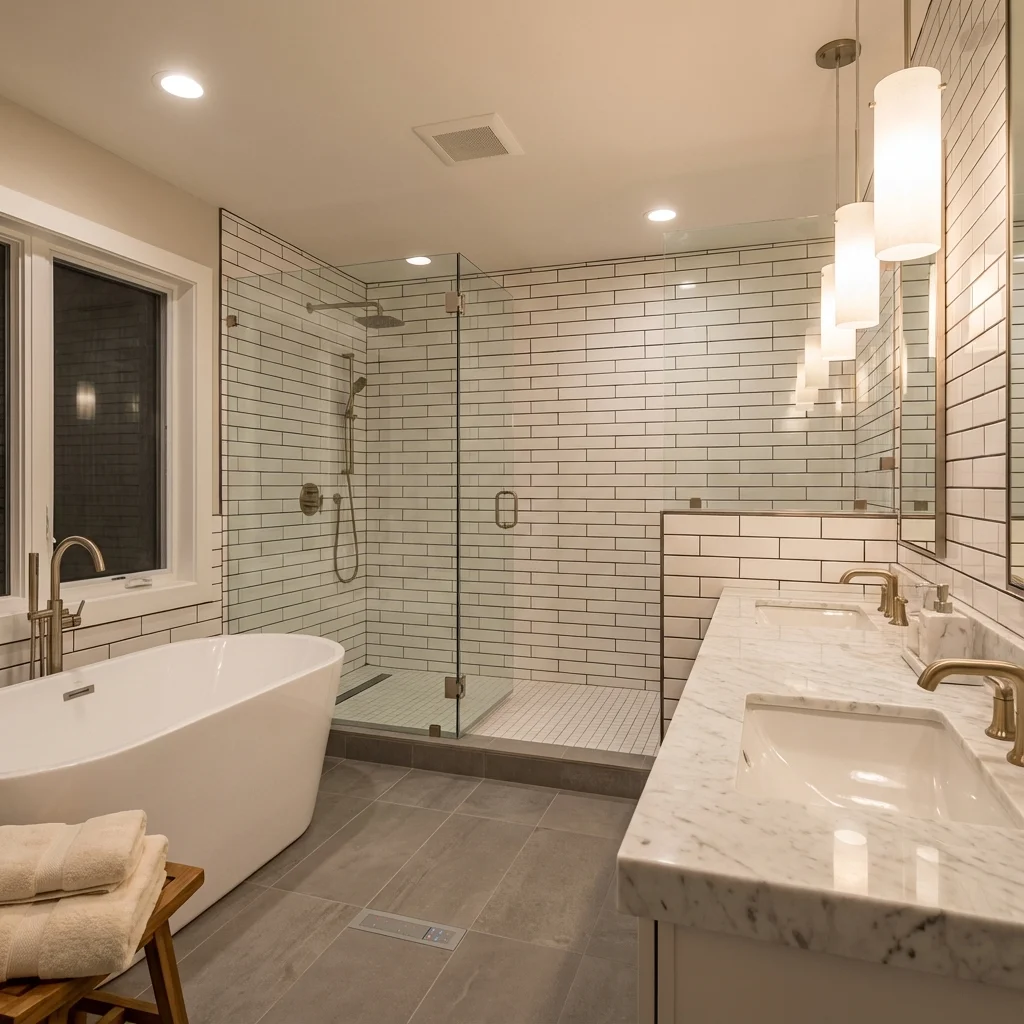
Walk into any Salt Lake City tile distributor—from Dal-Tile and Arizona Tile off I-15 to boutique European showrooms—and you will see porcelain formats spanning delicate 3x12 elongated pickets up to massive 24x48-inch architectural panels. Yet tile dimensions dictate far more than visual scale; they govern framing tolerances, mortar bed thickness, grout maintenance against Utah's mineral-heavy water, and installation labor costs. Choosing a 50% brick pattern on bowed 12x24 tiles or slapping 24x48 slabs over wavy 1980s wood studs guarantees unsightly shadow-casting lippage unless your tile setter engineers the substrate and layout pattern from the framing outward.
Why TCNA Standards Ban 50% Brick Offsets on 12x24 Porcelain Tile
When rectangular 12x24-inch porcelain clays fire at 2,200°F in high-speed roller kilns, thermal physics creates a slight upward crown at the center of the 24-inch span while the four corners drop slightly. If an installer lays 12x24 tiles in a traditional 50% half-brick running bond, the highest crowned midpoint of every row sits directly beside the lowest dipped corners of the rows above and below—creating sharp 1/16-inch+ uneven edges called lippage that catch grazing ceiling recessed lights. Under TCNA Handbook and ANSI A108.02 Section 4.3.8.2, any tile with an edge 15 inches or longer is restricted to a maximum 33% (one-third) staggered offset, vertical stack, or horizontal grid.
- ANSI A108.02 caps running-bond offsets at 33% maximum for any rectangular tile measuring 15 inches or longer
- Vertical or horizontal stacked 12x24 grids align corner-to-corner and elongate 8-foot Salt Lake basement ceilings
- Rectified machine-cut porcelain allows crisp 1/16"–1/8" grout joints versus 3/16" required on pressed-edge tile
24x24 and 24x48 Large-Format Tiles: Framing Sistering and 95% Coverage
Jumping from 12x24 to 24x48-inch large-format porcelain cuts horizontal and vertical shower wall grout lines by up to 75%, delivering a seamless marble-slab aesthetic with zero natural-stone sealing required. However, rigid four-foot porcelain planks cannot bend over bowed Douglas fir wall studs. Before hanging waterproof foam board, our carpenters check every stud wall with 6-foot and 8-foot aluminum straightedges, planing proud lumber or sistering straight engineered LSL studs until substrates achieve ANSI flatness within 1/8 inch over 10 feet and no more than 1/16 inch in 24 inches. Setters then directional-trowel medium-bed LFT mortar and back-butter every panel to achieve 95% wet-area bond coverage with mechanical lippage tuning clips.
- Large-format tile (LFT >= 15") mandates wall flatness within 1/8 inch per 10 feet before waterproofing begins
- 24x48 porcelain panels weigh 32–38 lbs each, requiring two-person suction handling and non-sag LFT polymer mortar
- Cutting grout lines by 75% dramatically slashes hard-water scrubbing time in 60"x36" walk-in showers
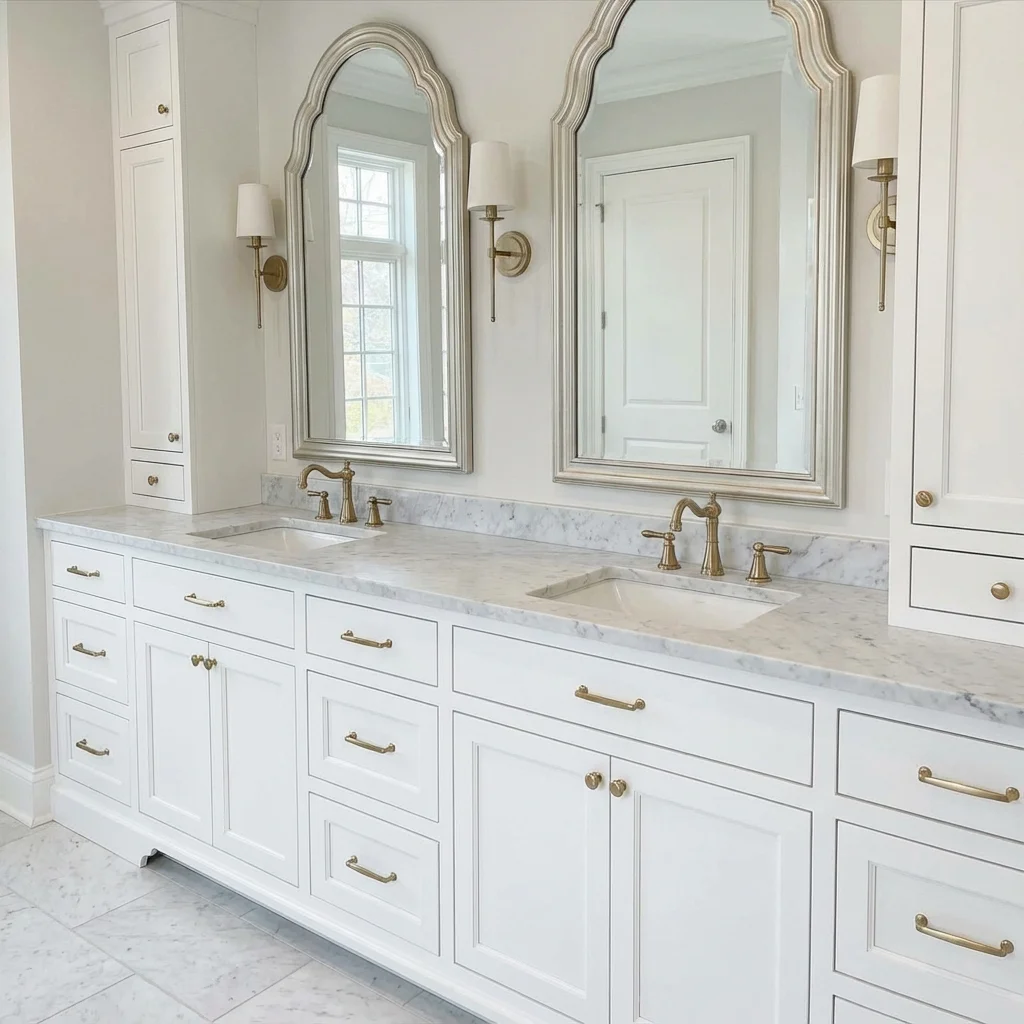
Picket, Herringbone, and Chevron Patterns: Waste Factors and Niche Math
Geometric tile layouts—including 3x12 hexagonal pickets, 45-degree herringbone, and mitered chevron feature walls—create extraordinary boutique texture on vanity backsplashes and focal shower walls, but demand surgical layout math prior to framing. Because diagonal cuts meet at every inside corner, shampoo niche perimeter, and ceiling line, material waste overage jumps from 10%–12% on stacked 12x24 grids up to 20%–25% on chevron and herringbone patterns. Furthermore, small-format mesh-mounted picket sheets telegraph every tiny trowel ridge or board seam, and add 400% more linear feet of grout. In wet Utah showers, we pair intricate geometric accent walls with stain-proof ANSI A118.3 epoxy or single-component urethane grout.
- Order 20%–25% extra tile overage for herringbone, chevron, and picket walls versus 12% for stacked rectangles
- Frame recessed shampoo niches AFTER dry-laying tile courses so niche borders hit full unbroken picket points
- Upgrade high-grout-density geometric feature walls to stain-proof, sealer-free high-performance or epoxy grout
L/360 Subfloor Deflection Engineering for Large Bathroom Floor Tiles
Before laying 24x24 porcelain tiles across a master bathroom floor in an older Holladay, Murray, or East Bench home framed with 2x8 or widely spaced 2x10 floor joists, structural bounce must be calculated carefully. TCNA standards mandate a minimum subfloor deflection stiffness of L/360 under combined live and dead loads for ceramic and porcelain tile—and twice-as-stiff L/720 framing if you opt for natural marble or travertine. If joists flex beyond L/360, rigid 24x24 tiles pop loose or crack straight through the body. Our crews sister floor joists where needed, screw down 3/4-inch tongue-and-groove subflooring every 6 inches, and bond Schluter Ditra uncoupling membrane to isolate lateral shear stresses.
- Porcelain tile floors require L/360 minimum joist stiffness; natural stone requires twice as rigid L/720 framing
- 24x24 main bathroom floors pair seamlessly with linear shower drains, eliminating awkward threshold transitions
- Uncoupling membranes absorb seasonal Utah indoor humidity shifts (18% winter RH to 45% summer) without cracking tile
Bathroom Porcelain Tile Sizes: Flatness Specs, Grout Load & Utah Pricing
| Porcelain Tile Format | Allowed Layout & Grout Joint | Material Waste & Grout Volume | Installed Salt Lake Cost / Sq. Ft. |
|---|---|---|---|
| 12"x24" Rectified Porcelain | Stacked or max 33% offset | 1/16"–1/8" | 10%–12% waste | Moderate grout | $18–$26 / sq. ft. (labor + prep + tile) |
| 24"x24" Large-Format Square | Straight grid or diamond | 1/16"–1/8" | 12%–15% waste | Low grout | $21–$29 / sq. ft. |
| 24"x48" Architectural Panel | Vertical/horizontal stack | 1/16" clip joint | 15%–18% waste | 75% less grout | $25–$36 / sq. ft. (includes stud truing) |
| Picket / Chevron / Herringbone | Geometric interlocking | 1/16"–1/8" | 20%–25% waste | High grout density | $28–$44 / sq. ft. |
Grant Helmer's Utah Field Pro-Tip (DOPL #10146123-5501)
Whenever a homeowner shows me crooked tile shadows in a friend's remodel, it is almost always 12x24 tile set in a 50% brick pattern under recessed can lights. Under DOPL #10146123-5501, our crews plane and sister wavy wall studs dead-flat with 8-foot straightedges before waterproofing so 24x48 and 12x24 courses sit laser-flush.
Frequently Asked Questions: 12x24 Vs 24x48 Shower Tile Layout Patterns
Does 24x48 large-format tile make a small 5x8 guest bathroom look smaller or bigger?
Counterintuitively, large 24x48 porcelain panels make compact 5x8 guest bathrooms look significantly larger, taller, and calmer. Because a 60-inch tub surround wall needs fewer than three vertical panels with ultra-thin 1/16-inch color-matched grout lines, your eye reads one continuous stone expanse rather than a busy grid.
Should 12x24 shower wall tiles be installed horizontally or vertically?
Horizontal stacked or 1/3-offset courses visually widen narrow 36-inch shower stalls and draw the eye around the perimeter, while vertical stacked 12x24 or 24x48 tiles draw the eye upward toward the ceiling—an ideal optical boost for 88-to-92-inch basement bathroom ceilings across West Jordan, Sandy, and Riverton.
Why does large-format tile installation cost more per square foot if there are fewer pieces to lay?
Although tile setters handle fewer individual pieces, large-format porcelain requires hours of carpentry stud-planing to meet strict 1/8-inch-in-10-feet flatness, two-person vacuum suction lifting, double back-buttering with polymer medium-bed mortar, mechanical leveling clips, and specialized bridge rail wet-saws to execute chip-free four-foot cuts.
Can I put 24x24 porcelain tile on the floor inside my walk-in shower?
Yes, if you install a wall-to-wall linear trench drain pitched in a single flat plane and verify the tile has a matte wet DCOF slip rating of 0.42 or higher. With a standard center drain, 24x24 tiles require diagonal 'envelope cuts' to fold toward the drain.
Related Utah Roofing, Bathroom & Remodeling Resources
Schedule Your Salt Lake County & Wasatch Front, UT Inspection or Design Quote
Direct owner consultation with Grant Helmer (Utah DOPL #10146123-5501) — zero high-pressure sales.