Whole-House Humidifier Settings for Utah Wood Floors & Custom Cabinets

The National Wood Flooring Association (NWFA) and cabinet makers require 30% to 50% relative humidity year-round, with 32% to 40% RH being the safe sweet spot during Utah winters (stepping down automatically to 25%–28% RH during sub-15°F cold snaps to prevent window condensation). Urban Design & Remodel (DOPL #10146123-5501, (801) 440-1952) integrates 240V steam humidifiers into Salt Lake County remodels.
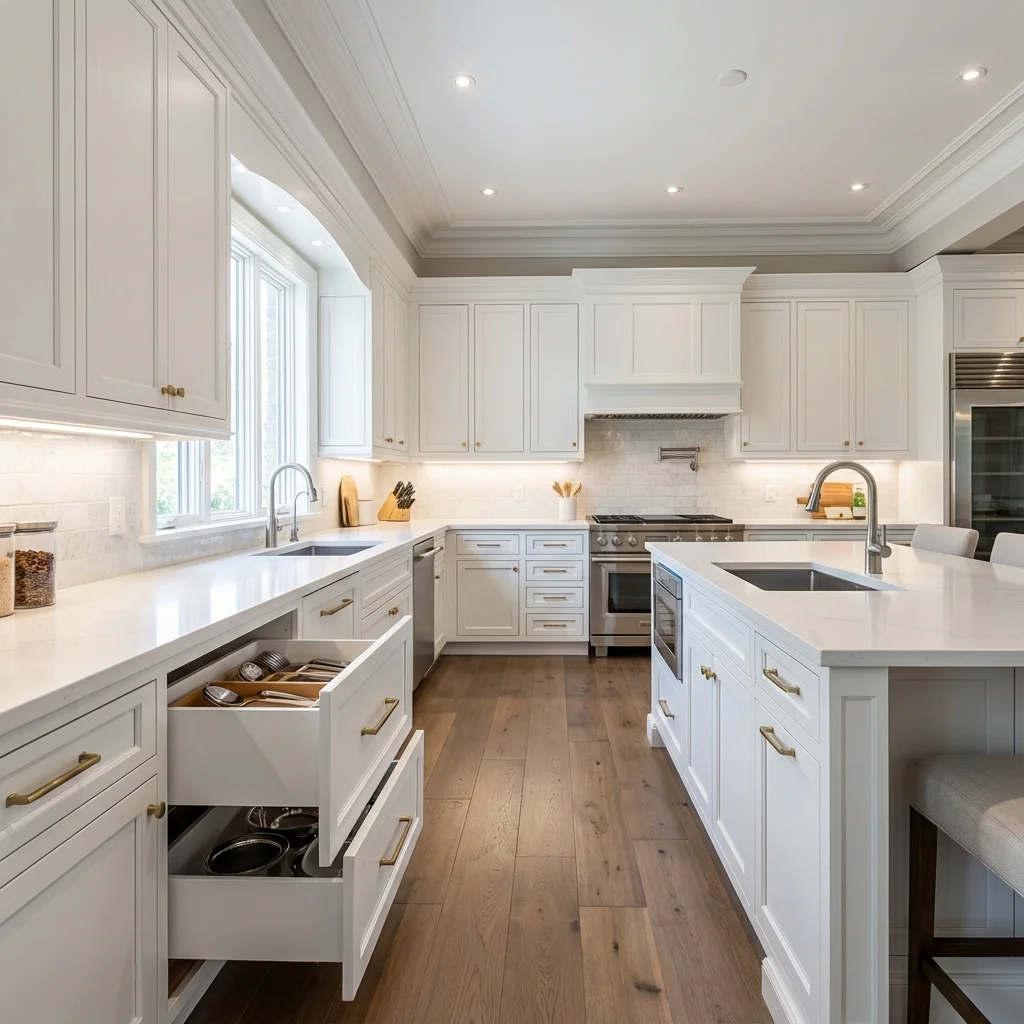
At 4,300 to 5,500 feet above sea level along the Wasatch Front, winter air holds remarkably little absolute moisture. When a gas furnace pulls 20°F outdoor Salt Lake Valley air into a home and heats it to 70°F without active humidification, indoor relative humidity plummets to 11%–16%—drier than Mojave Desert summer air. Hygroscopic materials inside a freshly remodeled home immediately surrender bound cellular moisture to that parched air: 7-inch-wide European white oak planks shrink, opening 1/16-inch winter gaps or splitting along grain lines (face checking), while painted maple shaker cabinet doors develop hairline cracks at rail-and-stile joints. Proper whole-home humidification protects six-figure millwork investments.
Why NWFA & KCMA Warranties Mandate 30%–50% Relative Humidity
Every reputable engineered hardwood mill (including Mirage, Monarch, and Hallmark) and custom Utah cabinet shop embeds an environmental warranty clause requiring homeowners to maintain indoor temperatures between 60°F and 80°F and relative humidity between 30% and 50% (some wide-plank European oak lines specify 35%–55%). Below 25% RH, wood equilibrium moisture content (EMC) drops below 5.2%. In wide engineered hardwood planks, the top 3mm to 4mm sawn white oak wear layer shrinks aggressively across its tangential grain while the cross-ply Baltic birch core resists movement—generating high internal tensile stress that triggers dry cupping, end-joint splits, or face checking that manufacturers classify as site desiccation rather than a defect.
- 35%–42% indoor RH keeps wood equilibrium moisture content stable near 7%–8% EMC along the Wasatch Front
- Uncontrolled 12%–16% Utah January furnace air voids virtually all solid and engineered wood floor warranties
- Smart Bluetooth hygrometers placed at floor level track real micro-climates far better than hallway thermostats
Steam Electrode Humidifiers vs Evaporative Bypass Pads in Hard Utah Water
Tract builders often bolt $450 evaporative bypass pad humidifiers onto furnace plenums, yet bypass units fail larger remodeled Utah homes for two physics reasons: first, they only evaporate moisture while the furnace burner actively blows hot plenum air, falling way behind on sunny 35°F winter afternoons; second, Salt Lake County's 14 to 20 grains-per-gallon (GPG) calcium-hard municipal water crusts honeycomb aluminum pads solid with limestone scale within six weeks. For homes featuring wide-plank hardwood and custom inset or shaker cabinetry, we install dedicated 240V electrode steam humidifiers (such as the AprilAire 800) wired to activate the HVAC blower fan independently, delivering up to 34.6 gallons of pure sterile steam daily.
- 240V electrode steam canisters boil water on demand even when high-efficiency modulating furnaces aren't heating
- Replaceable $95 annual steam canisters utilize Utah water minerals for conductivity without messy pad scraping
- Installed 240V steam humidifier upgrades run $1,850 to $3,100 including dedicated 20A/30A circuit and copper feed
Outdoor Temperature Reset Sensors: Stopping Window Sill Condensation
Leaving an old manual dial humidistat locked at 45% RH in mid-January creates a destructive secondary moisture hazard: when overnight outdoor temperatures in Draper, Sandy, or Bountiful plunge to 5°F, interior glass perimeter edges on older aluminum or builder dual-pane vinyl windows chill below the indoor dew point (~47°F at 70°F and 45% RH). Condensation streams down the glass onto wood window stools, breeding black mildew and swelling MDF casings. Digital automatic humidistats solve this via a wired outdoor temperature sensor mounted under a shaded north eave—automatically stepping indoor target humidity down by 1% for every 2°F outdoor drop so hardwood stays hydrated safely below your windows' frost point.
- Automatic outdoor sensor holds 38%–40% RH at 30°F outdoors, stepping down smoothly to ~26% RH during 0°F nights
- Triple-pane or warm-edge Low-E Argon windows tolerate 8%–10% higher winter RH without edge sweating
- Brief overnight step-downs to 26%–28% RH for 48 hours will not shock thick oak planks (wood responds over weeks)
Pre-Installation Wood Acclimation Before Turning On New Floors
Whole-house humidification must be commissioned and stabilized before custom hardwood cartons are ever stacked inside a Salt Lake County remodel—never switched on two weeks after planks are nailed or glued down in a parched 14% RH construction zone. Under strict NWFA installation guidelines, permanent HVAC heating and humidification must operate at normal occupied living conditions (65°F–72°F and 32%–42% RH) for at least five days prior to wood delivery. Our carpenters test both concrete or OSB subfloors and hardwood planks using calibrated Wagner Orion pinless meters and Lignomat insulated-pin meters, documenting with timestamped photos that wide engineered oak sits within 2% moisture content of the wood subfloor before spreading urethane adhesive.
- HVAC and whole-house humidifier must stabilize at 32%–42% RH for 5+ days prior to wood floor acclimation
- Narrow planks (<5" wide) require <=4% MC spread from subfloor; wide planks (>=5" wide) require strict <=2% spread
- Never run unvented propane construction heaters indoors—they dump excessive vapor spike followed by severe crash
Utah Winter Outdoor Temp vs Safe Indoor Humidity Target & Equipment Matrix
| Wasatch Outdoor Temp | Max Safe Indoor RH (Dual-Pane) | Wood EMC Stability | Recommended Control Action |
|---|---|---|---|
| 30°F to 45°F (Mild Winter) | 38% – 42% RH | 7.4% – 8.0% EMC (Ideal) | Standard automatic steam humidistat target |
| 15°F to 29°F (Typical Jan) | 32% – 36% RH | 6.5% – 7.1% EMC (Safe) | Auto outdoor sensor trims target slightly |
| 0°F to 14°F (Cold Inversion) | 25% – 30% RH | 5.6% – 6.2% EMC (Short-term OK) | Prevents ice rims on north-facing window sills |
| No Humidifier Installed | 11% – 16% RH (Danger Zone) | 3.0% – 3.8% EMC (Cracking Risk) | Voids NWFA/KCMA warranties; install steam unit |
Grant Helmer's Utah Field Pro-Tip (DOPL #10146123-5501)
Whenever we build a custom white oak kitchen and wide-plank hardwood main floor in Salt Lake County (DOPL #10146123-5501), I include an AprilAire 800 steam humidifier right in the mechanical scope. Spending $2,400 upfront protects $60,000+ of custom cabinetry and hardwood from winter shrinkage cracks—and stops dry winter bloody noses for your family too.
Frequently Asked Questions: Ideal Indoor Humidity For Wood Floors Utah Winter
Should a steam humidifier connect to softened water or unsoftened cold water in Utah?
Electrode steam humidifiers like the AprilAire 800 actually require natural minerals in the water to conduct electricity between electrodes—so pure reverse-osmosis water won't work! Depending on local hardness (14–20 GPG in Salt Lake Valley), connecting to cold unsoftened or softened water works great using the matching standard or high-output canister.
Do luxury vinyl plank (LVP) floors require a whole-house humidifier in Utah?
Rigid-core SPC and WPC vinyl planks are non-hygroscopic plastics and limestone composites, meaning dry 15% winter humidity will not shrink or split LVP planks. However, wood baseboards, interior shaker doors, piano soundboards, and kitchen cabinets in the same home still benefit enormously from 32%–40% winter humidity.
Will hairline winter paint cracks on maple shaker cabinet doors close back up?
Center panels on five-piece solid maple shaker doors are intentionally floated on flexible rubber spaceballs so wood rails can move seasonally without splitting panels. Once indoor relative humidity rebounds into the 35%–40% range, slight winter joint lines tighten back up, though severely desiccated corner enamel cracks may need touch-up.
Can portable room humidifiers protect 1,800 square feet of main-floor hardwood?
Rarely—open-concept two-story Utah homes exchange enough air that maintaining 35%+ RH in January requires adding 12 to 25 gallons of water vapor daily. Portable ultrasonic units would require refilling four tanks every day and often leave white calcium mineral dust across dark floors and furniture.
Related Utah Roofing, Bathroom & Remodeling Resources
Schedule Your Salt Lake County & Wasatch Front, UT Inspection or Design Quote
Direct owner consultation with Grant Helmer (Utah DOPL #10146123-5501) — zero high-pressure sales.