
Choosing Bathroom Tile Grout Width: 1/16-Inch Rectified vs. Calibrated Pressed Tile

Rectified porcelain tiles are mechanically diamond-sawn or laser-ground after kiln firing to achieve razor-sharp 90-degree edges and dimensional uniformity within ±0.5mm, enabling sleek, easy-clean 1/16-inch to 1/8-inch grout joints. Non-rectified (calibrated/pressed) tiles emerge from kiln shrinkage with slightly beveled edges requiring wider 3/16-inch joints. Urban Design & Remodel (Utah DOPL #10146123-5501, (801) 440-1952) enforces TCNA ANSI A108.02 substrate flatness so narrow joints stay lippage-free.
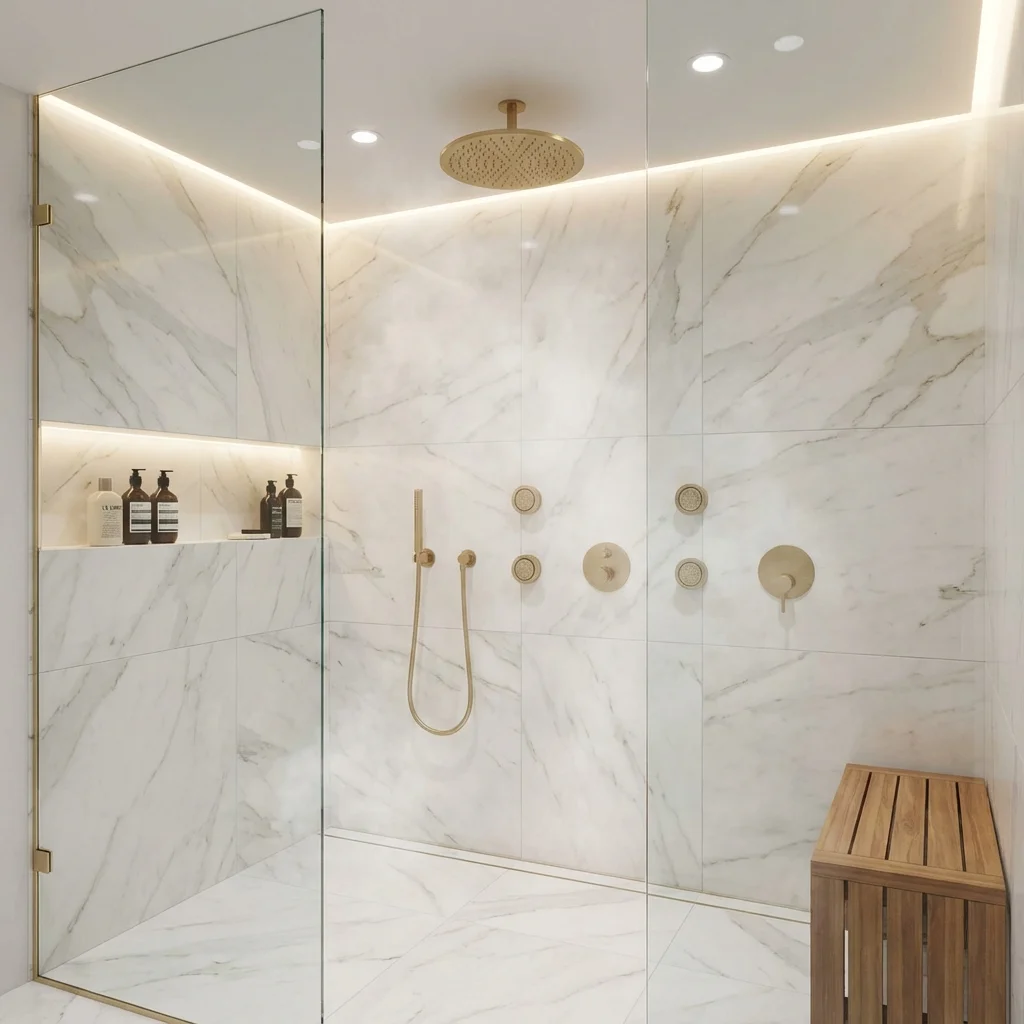
Ask almost any Salt Lake County homeowner what they hate most about their existing 20-year-old master shower and the answer is instantaneous: scrubbing wide, sandy, discolored 1/4-inch grout joints stained by Utah's iron-and-calcium-heavy water and soap residue. Walk into a modern tile showroom in South Salt Lake or Sandy today and you will see monolithic 24x48-inch porcelain slabs set with hairline joints that make walls look carved from continuous Italian travertine or limestone. Achieving those razor-thin 1/16-inch joints—without ugly jagged shadows or chipped tile corners—depends entirely on selecting true rectified porcelain, flattening framing studs to within 1/8 inch in 10 feet, and pairing high-performance urethane or epoxy grout.
Kiln Shrinkage Physics: Why Pressed Tiles Need 3/16" Joints While Rectified Allows 1/16"
When wet clay and feldspar enter a 2,200°F roller kiln to vitrify into impervious porcelain (<0.5% water absorption), every slab shrinks by roughly 7% to 10%. Standard 'pressed' or 'calibrated' tiles are sorted by optical scanners into matching size groups after firing, yet still retain a natural ±1.5mm to 2mm size tolerance and soft, rounded 'pillowed' edges. If a tile setter tries forcing calibrated tiles onto 1/16-inch spacers, cumulative size variations force grout lines to wander crookedly down a 9-foot shower wall, while pillowed bevels trap wider ribbons of grout on the surface anyway. Rectified tiles undergo a secondary precision diamond-grinding pass post-kiln, squaring all four edges to exact 90-degree tolerances so 1/16-inch or 3/32-inch joints track laser-straight.
- ANSI A108.02 rule: Minimum grout width must equal at least 3x actual dimensional variation within the tile lot
- Sharp 90-degree rectified edges sit flush with grout planes—eliminating sunken bevel troughs that collect soap scum
- Never butt tile edges tightly together with 'zero grout'; thermal expansion and vapor pressure will pop tiles loose
TCNA Lippage Control: Flattening Bowed Utah Wall Studs Before Setting Large Tile
Sharp rectified edges are mercilessly honest about wall flatness. Because rectified tiles lack forgiving rounded shoulders, even a 1/16-inch height difference between two adjacent 24x48-inch tiles ('lippage') catches overhead recessed shower LEDs and casts dark horizontal shadow lines. For tiles with any edge 15 inches or longer, Tile Council of North America (TCNA) standards mandate flattening substrates to within 1/8 inch across 10 feet (twice as strict as standard framing!). In arid Utah where kiln-dried Douglas fir studs routinely crown or twist 1/4 inch, we plane high studs, sister laser-plumbed furring strips during framing before hanging Wedi/Kerdi board, and use mechanical wedge-clip leveling systems (Raimondi or Peygran) exclusively to hold wet mortar flat—never to bend crooked tiles.
- Large-format tile (>15" edge) requires substrate flatness <=1/8 inch in 10 ft and <=1/16 inch in 24 inches
- Running brick-bond 50% offsets on bowed rectangular plank tiles guarantees center lippage; TCNA limits offset to <=33%
- 95% mortar coverage (ANSI A108.5) via directional troweling and back-buttering prevents hollow rectified corners
Choosing Stain-Proof Grout for Tight Joints: Epoxy vs. High-Performance Micro-Aggregate
Old-fashioned sanded Portland cement grout relies on coarse silica sand grains sized for 1/8-inch to 1/2-inch joints—forcing coarse sand into a 1/16-inch rectified joint scratches polished glazes and leaves pinholes—while unsanded cement grout shrinks and cracks over time. Today, we abandon porous traditional cement grouts completely in Utah bathrooms. For razor-thin 1/16-inch to 1/8-inch rectified shower joints, we install either 100%-solids RG epoxy grout (Laticrete Spectralock Pro Premium) or fine-micro-aggregate rapid-setting calcium aluminate grouts (Mapei Ultracolor Plus FA or Bostik Vivid). Both require zero periodic sealing, cure to uniform color without blotchy efflorescence, and shrug off hard-water minerals and shampoo dyes.
- Mapei Ultracolor Plus FA works continuously from 1/16" up to 3/4" joints with built-in DropEffect water repellency
- 100%-solids Spectralock epoxy grout is completely non-porous—ideal for shower pan mosaic floors and niches
- All changes of plane (wall-to-wall corners, wall-to-pan, curb-to-glass) receive color-matched 100% ASTM C920 silicone—never hard grout!
When Non-Rectified Pillowed or Artisan Tile Still Wins aesthetically
Does rectified porcelain mean pressed or handmade tile has no place in a luxury Salt Lake remodel? Not at all—provided tile geometry matches your architectural vibe and cleaning expectations. In historic Harvard-Yale, Avenues, or Sugar House Tudor cottages, machine-sharp 24x48 rectified slabs can feel overly clinical, whereas classic pressedsubway ceramics, tumbled marble mosaics, or hand-cut Moroccan Zellige embrace intentional surface movement and soft edges. Similarly, on curbless shower pan floors pitched 1/4 inch per foot toward a central square drain, 2x2-inch mosaics with frequent grout lines provide critical wet-foot traction (DCOF >= 0.42), whereas 24x48 rectified slabs on a shower floor require a wall-to-wall single-plane linear trench drain.
- Single-slope linear drains allow matching 24x48 rectified floor tiles with minimal 1/16"–3/32" wet-floor grout lines
- Tone-on-tone grout matching (warm greige grout on limestone porcelain) visually erases even 1/8" joints
- Contrasting dark charcoal grout against white tile highlights every tiny kiln tolerance—reserve ONLY for rectified tile
Bathroom Tile Edge Engineering & Grout Joint Specification Matrix
| Tile Classification | Recommended Grout Width | Best Utah Bath Application | Installed Tile + Prep Tier |
|---|---|---|---|
| Rectified Large-Format Porcelain (24x48) | 1/16" – 3/32" (1.5–2.5mm) | Low-maintenance primary shower walls & heated floors | $26 – $38 / sq ft (Includes stud planing) |
| Rectified Wood-Look Porcelain Plank (8x48) | 3/32" – 1/8" (Max 33% offset) | Kids' tub-splash floors & mountain-modern baths | $22 – $32 / sq ft |
| Calibrated Pressed Ceramic/Porcelain | 1/8" – 3/16" (3–5mm) | Classic subway hall baths & budget-friendly walls | $17 – $25 / sq ft |
| Handmade Zellige / Organic Glazed Clay | 1/16" Stacked – 3/16" Organic | Dry vanity backsplash walls & feature niches | $32 – $52 / sq ft (Artisan labor) |
Grant Helmer's Utah Field Pro-Tip (DOPL #10146123-5501)
Here is my favorite field test you can run right inside any Salt Lake tile showroom (DOPL #10146123-5501): pull two sample tiles from the rack and place them face-to-face like a sandwich, then rock the corners diagonally. If they rock or clack like a wobbly restaurant table, the tile has kiln bow—never set bowed rectangular tile in a 50/50 brick pattern or lippage is guaranteed!
Frequently Asked Questions: Rectified Vs Calibrated Porcelain Tile Grout Lines
Can rectified porcelain tile be installed with zero grout lines ('butt-jointed')?
No. Even diamond-cut rectified tiles expand and contract microscopically during hot 105°F showers vs. cool mornings, and TCNA ANSI A108.02 strictly prohibits grout joints narrower than 1/16 inch. Butt-jointed tiles chip edges during setting and let capillary moisture seep behind corners without a full grout seal.
Why did the grout crack right down the inside corners of my old tiled shower?
Wood framing along Utah's Wasatch Front expands and contracts seasonally between humid summers and dry 20%-humidity winters. Packing rigid cement grout into 90-degree corner changes of plane guarantees hairline cracks; TCNA EJ171 requires flexible 100% color-matched silicone in every corner.
Does epoxy grout turn yellow over time in sunlit Utah bathrooms?
Early-generation industrial epoxies could amber slightly in bright UV light on bright-white joints, which is why we specify modern UV-stabilized formulations like Laticrete Spectralock 1 or Mapei Ultracolor Plus FA around skylit showers and windows.
Is 24x48-inch rectified porcelain tile too heavy for standard bathroom walls?
Not when anchored over properly fastened 1/2-inch Wedi XPS foam board or cement backer board screwed into 16-inch on-center studs with ANSI A118.15 non-sag large-and-heavy-tile (LHT) thinset mortar, which easily supports slabs weighing 5 to 7 lbs per square foot.
Related Utah Roofing, Bathroom & Remodeling Resources
Schedule Your Salt Lake County & Wasatch Front, UT Inspection or Design Quote
Direct owner consultation with Grant Helmer (Utah DOPL #10146123-5501) — zero high-pressure sales.