
Epoxy Grout vs. High-Performance Cement Grout in Utah Showers

For Salt Lake County showers exposed to 14–20 GPG hard water, two-part ANSI A118.3 epoxy grout like Laticrete Spectralock Pro Premium offers <0.5% water absorption, zero sealing requirements, and superior resistance to acidic scale cleaners, adding $450–$850 over standard grout. High-performance ANSI A118.7 polymer-modified cement grout like Mapei Ultracolor Plus FA eliminates efflorescence at lower labor cost. Urban Design & Remodel (Utah DOPL #10146123-5501, (801) 440-1952) specifies grout chemistry based on pan mosaic density.
Along the Wasatch Front, municipal water supplies drawn from Big Cottonwood, Parleys, and Jordan Valley aquifers carry 14 to 20 grains per gallon of dissolved calcium carbonate and magnesium. When homeowners scrub hard-water mineral crusts off shower floors with low-pH descalers or vinegar solutions, ordinary Portland cement sanded grout rapidly erodes, pits, and turns into a porous sponge for pink Serratia bacteria and mildew. Choosing the right joint chemistry—whether true two-part thermoset epoxy, premixed single-component urethane/acrylic dispersion, or calcium-aluminate rapid-setting cement grout—determines whether your custom tiled shower stays bright and sanitary for twenty years or demands annual stripping and resealing.
ANSI A118.3 Two-Part Epoxy Grout: Laticrete Spectralock Pro Premium
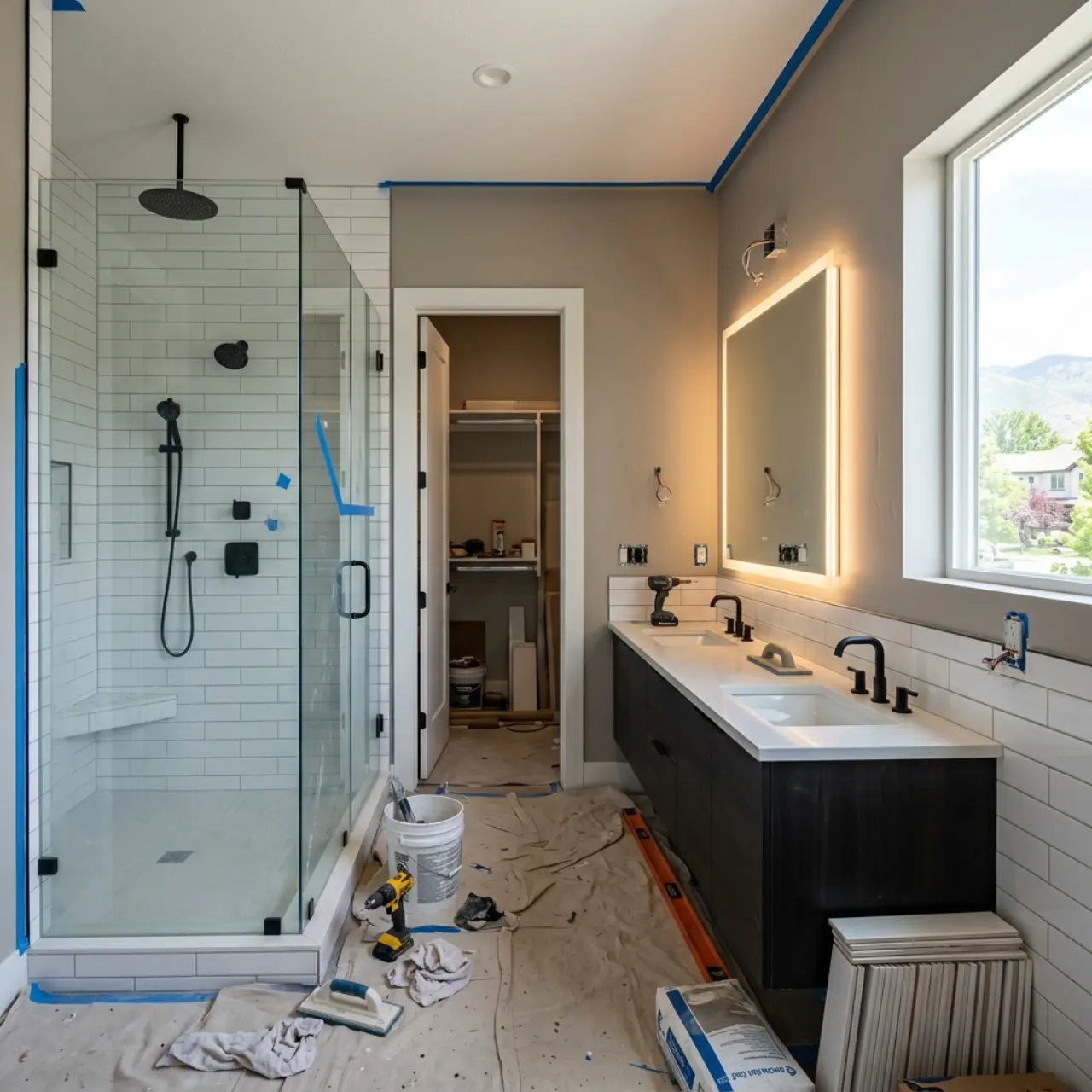
True epoxy grout relies on a liquid epoxy resin (Part A), a chemical hardener (Part B), and color-coated quartz aggregate filler (Part C) rather than Portland cement hydration. Tested under ANSI A118.3, Laticrete Spectralock Pro Premium cures to a non-porous matrix with less than 0.5% water absorption and over 3,500 psi compressive strength. In small-format 2x2 shower pan mosaics where standing water lingers around linear or point drains, epoxy prevents dye staining from purple toning shampoos and resists mild sulfamic or citric acid hard-water cleaners. Because epoxy pot life shrinks to 45–60 minutes at 70°F and leaves an irreversible plastic resin haze if not emulsified promptly with microfiber pads, professional installation adds $4.50 to $7.50 per square foot.
- Meets ANSI A118.3 with <0.5% water absorption and >3,500 psi compressive strength
- Never requires penetrating fluoropolymer sealers over its 20+ year service life
- Ideal for multi-joint 2x2 porcelain shower floors and recessed shampoo niches
ANSI A118.7 High-Performance Cement: Mapei Ultracolor Plus FA
Modern high-performance cement grouts bear little resemblance to the $18 bagged sanded Portland grout sold in big-box aisles. Formulated with calcium aluminate cement and DropEffect hydrophobic polymers under ANSI A118.7, Mapei Ultracolor Plus FA and Laticrete Permacolor Select eliminate free lime, completely stopping the chalky white efflorescence blooms common in Utah's arid winter air. Its fine-aggregate gradation accommodates tight 1/16-inch rectified porcelain wall joints all the way up to 3/4-inch rustic stone joints without shrinkage cracking. While it spreads and sponges off twice as fast as two-part epoxy—saving $450 to $850 on an average West Jordan primary shower—it still retains minor capillary porosity and benefits from a penetrating sealer every 3 to 5 years on horizontal pans.
- Calcium-aluminate chemistry prevents chalky white efflorescence in dry Utah air
- Fine aggregate fits 1/16" rectified slab joints without scratching polished glazes
- Installs at $1.50–$2.50/sq ft baseline labor vs $6.00+/sq ft for two-part epoxy
Premixed Urethane and Acrylic Grouts: Submerged Pan Limitations
Single-component premixed grouts—such as Bostik TruColor RapidCure urethane or Mapei Flexcolor CQ quartz-acrylic—cure through water evaporation rather than chemical cross-linking. While DIYers love resealable buckets with zero mixing ratios, evaporative curing creates serious vulnerabilities inside wet Salt Lake County showers. If installed over an impermeable sheet membrane like Schluter-KERDI and dense <0.5% absorption porcelain tile, trapped moisture cannot escape downward, slowing full cure to 7–14 days. Worse, several premixed acrylic/urethane manufacturers restrict or void warranties in submerged applications, steam rooms, or pebbles with deep voids where latent moisture re-emulsifies the binder into a gummy paste. We restrict premixed acrylic grouts strictly to dry vanity backsplashes and vertical accent walls.
- Evaporative cure stalls for days when sandwiched between KERDI membrane and porcelain
- Prohibited in residential steam showers and deep river-rock pebble shower pans
- Best reserved for vertical bathroom accent walls and dry vanity backsplashes
Why Traditional Portland Sanded and Unsanded Grouts Fail Fast
Standard ANSI A118.6 Portland cement sanded grout cures slowly, sheds calcium hydroxide salts as mix water evaporates, and exhibits water absorption rates exceeding 10% to 14%. In a daily-use Sandy or Draper family shower, unsealed traditional grout wicks soap scum, body oils, and hard-water iron deposits deep into its capillary network within six months. Furthermore, traditional unsanded grout shrinks and cracks if joints exceed 1/8 inch, while coarse sanded aggregate scratches delicate polished marble and glass accent tiles. Even when sealed annually with a $45 bottle of solvent-based fluorochemical sealer, hot shower water and alkaline body washes strip surface protection rapidly, making legacy ANSI A118.6 grout obsolete for custom bathroom remodeling.
- Absorbs 10%–14% moisture by weight, breeding sub-surface mildew and discoloration
- Requires annual chemical resealing and neutral-pH cleaners to prevent joint pitting
- Prone to blotchy pigment shading and shrinkage pinholes when over-washed during install
Shower Grout Chemistry Comparison for Wasatch Front Bathrooms
| Grout Classification | ANSI Standard & Absorption | Installed Upgrade Cost (100 SF) | Sealing & Shower Suitability |
|---|---|---|---|
| Two-Part Epoxy (Spectralock Pro) | ANSI A118.3 (<0.5% water uptake) | +$550 – $850 over baseline | Zero sealing ever; best for shower pans & niches |
| Calcium-Aluminate (Ultracolor FA) | ANSI A118.7 (~3%–4% water uptake) | Included in standard custom bid | Optional pan seal every 3–5 yrs; ideal for walls |
| Premixed Urethane / Acrylic CQ | Non-ANSI evaporative dispersion | +$250 – $450 over baseline | No sealing; avoid in steam & flat pebble pans |
| Legacy Sanded Portland Cement | ANSI A118.6 (10%–14% uptake) | Not installed by Urban Design | Mandatory yearly sealing; high efflorescence risk |
Grant Helmer's Utah Field Pro-Tip (DOPL #10146123-5501)
As a Utah contractor (DOPL #10146123-5501), my favorite value-engineered hybrid spec is installing Laticrete Spectralock Pro epoxy strictly on the horizontal shower pan, curb top, bench seat, and shampoo niche—where soap and hard water pool—while running color-matched Mapei Ultracolor Plus FA on vertical 24x48 walls. You get bulletproof stain immunity underfoot while saving $450 in wall-grouting labor.
Frequently Asked Questions: Epoxy Grout Vs Urethane Vs Cement Grout Shower
Does epoxy grout turn yellow over time in bright bathrooms?
Bright white two-part epoxy grouts contain aromatic resins that can amber slightly when exposed to direct UV sunlight from an unshaded south-facing skylight or clear window. In sunlit Salt Lake bench bathrooms, we specify light warm gray, almond, or aliphatic non-yellowing grout formulations on sun-drenched walls.
Can you use epoxy grout on natural Carrara marble shower tile?
Carry caution with unsealed porous stone: epoxy resins can darken the raw cut edges of white Carrara or Thassos marble in termed 'picture framing,' and aggressive epoxy scrub pads scratch honed stone. Always pre-seal marble faces with a tile-release coating and test a mock-up board first.
Why should shower corners never be filled with epoxy or cement grout?
Per TCNA EJ171 movement joint standards, all changes of plane—vertical wall corners, wall-to-pan perimeters, and curb junctions—expand and contract differentially across Utah's dry winters. Even 3,500-psi epoxy will shear at framing corners; always gun 100% ASTM C920 color-matched silicone into every corner.
How soon can we use our shower after grouting with Ultracolor Plus FA or Spectralock?
Mapei Ultracolor Plus FA cures rapidly for light foot traffic in 3 to 4 hours, though we enforce a 24-hour wait before hot water exposure. Laticrete Spectralock Pro epoxy requires 24 hours at 70°F before light shower spray and 7 days before steam shower operation.
Related Utah Roofing, Bathroom & Remodeling Resources
Schedule Your Salt Lake County & Wasatch Front, UT Inspection or Design Quote
Direct owner consultation with Grant Helmer (Utah DOPL #10146123-5501) — zero high-pressure sales.