
Does a New Metal or Shingle Roof Make Noise in Rain & Hail? Acoustic Facts

No—when installed over solid 7/16-inch or 5/8-inch OSB roof decking, heavy synthetic or peel-and-stick underlayment, a vented attic with R-49+ insulation, and drywall ceilings, a residential metal roof registers 48 to 52 dBA during heavy rain, virtually indistinguishable from asphalt shingles at 46 to 49 dBA. Tinny 'barn roof' noise (70+ dBA) only occurs on uninsulated open-frame sheds. Contact Urban Design & Remodel at (801) 440-1952 (DOPL #10146123-5501).

Ask ten Salt Lake County homeowners why they hesitate to put standing-seam metal, stone-coated steel, or metal porch accents over a second-floor bedroom, and eight will bring up childhood memories of deafening rain pounding on an uninsulated cabin or farm shed roof. Meanwhile, remote professionals working from vaulted upstairs offices in South Jordan, Draper, and Holladay also ask how a full roof replacement dampens I-15 highway drone, Salt Lake International flight paths, and violent May hailstorms. Acoustic testing proves that rooftop noise depends ninety percent on the structural deck, underlayment damping, and attic assembly beneath the covering—not whether the outer surface is steel or ceramic-coated asphalt.
Decibel Physics: Open-Purlin Barns (72 dBA) vs. Solid OSB Assemblies (48 dBA)
Sound intensity operates on a logarithmic decibel scale where every 10-dBA drop cuts perceived loudness in half. Agricultural pole barns fasten thin 29-gauge corrugated metal directly onto open 2x4 wood purlins with zero solid sheathing, zero underlayment, and zero ceiling drywall—turning each steel sheet into an un-damped drumhead resonating at 72 to 76 dBA during a Wasatch cloudburst. By contrast, Utah residential roofs sit atop continuous APA-rated structural OSB or CDX plywood decking. Solid wood mass coupled with non-woven polypropylene synthetic underlayment absorbs high-frequency raindrop impact vibration at the point of contact, dropping interior living-space sound levels down to whisper-quiet library levels (46 to 52 dBA).
- 46 dBA (asphalt shingle) vs. 50 dBA (standing seam over solid OSB + R-49 attic) = barely perceptible 3–4 dBA difference.
- Human conversation averages 60 dBA; refrigerator hum is 42–45 dBA—meaning heavy rain stays quieter than normal talk.
- Stone-coated steel panels carry a textured stone-chip acrylic coating that breaks up raindrop impact even further.
How New Re-Nailed OSB Decking & Peel-and-Stick Membranes Kill Vibration
If your 1980s or 1990s Utah home currently sounds creaky in canyon winds or loud during rainstorms, loose roof sheathing and dried-out 15-lb organic paper felt are usually to blame. Old smooth-shank box nails back out of OSB over decades of extreme summer/winter expansion cycles, allowing panels to chatter and transmit airborne noise. During a full tear-off, our crews replace delaminated sheets with crisp 7/16-inch or 1/2-inch OSB, re-fasten every existing sheet with 8d ring-shank nails at 6-inch perimeter / 12-inch field spacing, and lay heavy multi-ply synthetic underlayment or 40-mil to 60-mil rubberized SBS peel-and-stick membrane. Self-adhered rubberized membranes act exactly like automotive Dynamat acoustic deadening pads across your roof deck.
- 60-mil SBS rubberized peel-and-stick underlayment adds viscoelastic mass-damping that kills high-frequency hail ping.
- Upgrading to 5/8-inch CDX/OSB decking during re-sheathing boosts STC (Sound Transmission Class) by 3 to 4 points.
- Ring-shank deck re-nailing eliminates night-time wood popping and wind-induced panel rattle.
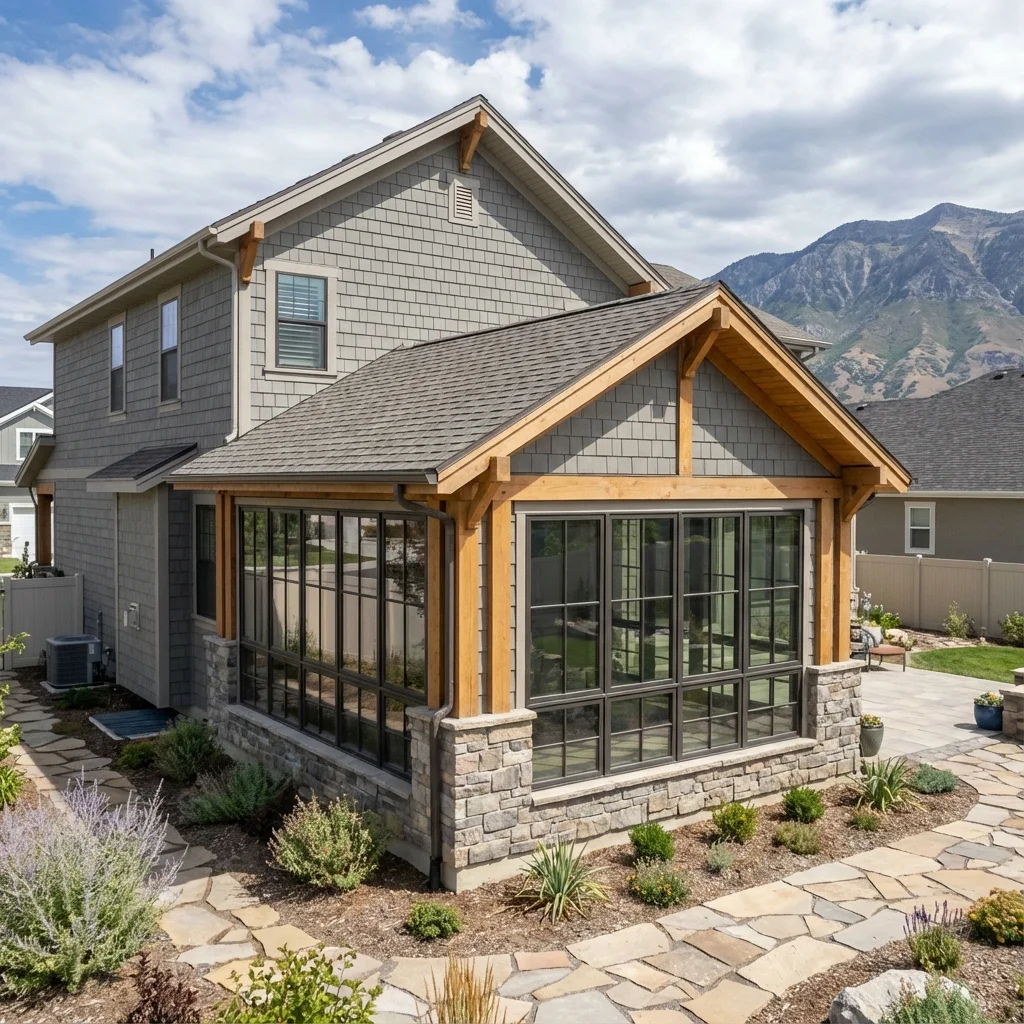
Vaulted Ceilings vs. Vented R-49+ Attics: Where Extra Sound Control Matters
Standard flat-ceiling bedrooms in West Jordan, Riverton, and Sandy benefit from a massive natural sound trap: 14 to 18 inches of fluffy R-49 to R-60 blown fiberglass or dense-pack cellulose sitting inside a vented attic airspace above 1/2-inch gypsum drywall. That insulated cavity easily delivers an STC rating of 50 to 54. However, mid-century Olympus Cove ramblers and modern vaulted primary suites lack a deep attic buffer because rafters sit inches above interior ceilings. On vaulted assemblies where standing-seam metal is planned, adding high-density polyisocyanurate rigid foam nailbase boards or entangled-mesh acoustic drainage mats beneath the metal panels stops direct structural Flanking transmission cold.
- Topping up under-insulated attics from R-19 to Utah's R-49/R-60 benchmark cuts exterior storm and flight-path noise by ~40%.
- Vaulted cathedral assemblies benefit from full-deck high-temp peel-and-stick membrane + rigid polyiso acoustic boards.
- Class 4 SBS rubber-modified shingles absorb spring pea-to-quarter hail noticeably quieter than brittle oxidized 3-tab shingles.
Sealing Roof Penetrations: The Hidden Acoustic Flanking Pathways
Acoustic engineers know that a tiny 1% unsealed air gap through an envelope assembly can leak up to 30% of airborne street, aircraft, and wind-howl noise into an attic. Old rattling galvanized wind-turbine ('whirlybird') vents, loose sheet-metal furnace flue collars, and oversized bath-fan deck cutouts let exterior roar bypass your roof sheathing entirely. When Urban Design & Remodel replaces a roof, we strip noisy squeaking turbines in favor of aerodynamic, externally baffled continuous ridge vents lined with non-woven weather filter media—eliminating mechanical moving parts, stopping wind whistle during 60-mph canyon gusts, and sealing every plumbing and exhaust curb airtight.
- Removing squeaky spinning turbine vents eliminates mechanical bearing whine and open acoustic holes into your attic.
- Externally baffled ridge vents with internal fiber matrices quiet high-wind whistling while boosting exhaust airflow.
- Insulating and sealing around bath-fan exhaust housings stops bathroom ceilings from acting as rooftop megaphones.
Interior Rainstorm Sound Level & STC Comparison by Roof Assembly
| Roofing Assembly Type | Heavy Rain Interior dBA | Estimated STC Rating | Real-World Indoor Acoustic Feel |
|---|---|---|---|
| Bare Metal on Open Barn Purlins (No Deck) | 71 – 76 dBA | STC 22 – 26 | Loud vacuum-cleaner roar; difficult to talk |
| Standing Seam Metal + OSB + Peel & Stick + R-49 | 48 – 52 dBA | STC 49 – 52 | Gentle, soothing distant rain; whisper-quiet |
| Stone-Coated Steel + Solid OSB + R-49 Attic | 47 – 50 dBA | STC 50 – 53 | Granule coating diffuses drops; matches shingles |
| Class 4 SBS Shingles + OSB + Synthetic + R-49 | 46 – 49 dBA | STC 51 – 54 | Quietest residential assembly against hail & traffic |
Grant Helmer's Utah Field Pro-Tip (DOPL #10146123-5501)
When we install standing-seam metal porch roofs right outside second-story master bedroom windows in Draper or South Jordan (DOPL #10146123-5501), I always specify solid 5/8-inch sheathing wrapped 100% in 60-mil rubberized high-temp ice-and-water shield before laying panels. That rubberized membrane kills metallic rain ping completely so open bedroom windows stay peaceful.
Frequently Asked Questions: Does Metal Or Shingle Roof Make Noise In Rain Hail
Will a metal porch roof outside my upstairs bedroom window wake me up in rain?
Not if built properly. Porch accents only ring loudly when contractors lay thin 29-gauge metal over open framing or thin paper felt. Installing 24-gauge architectural panels over solid 5/8-inch sheathing and full-coverage 60-mil rubberized peel-and-stick membrane dampens raindrop resonance to a soft, pleasant patter.
Do Class 4 SBS rubberized asphalt shingles quiet hailstorms better than standard shingles?
Yes. Standard oxidized asphalt shingles stiffen in cold spring air and click sharply under hailstones. Polymer-modified SBS Class 4 shingles retain rubber-like elasticity down to freezing temperatures, cushioning hail impact energy while resisting granule bruising.
Can adding blown attic insulation during a reroof block jet or highway noise?
Substantially. Upgrading an older Salt Lake Valley attic from settled 5-inch R-15 insulation up to 16+ inches of R-49/R-60 blown cellulose or fiberglass—combined with re-nailed OSB roof decking—dramatically attenuates low- and mid-frequency road and flight-path noise.
Why does my metal roof make popping sounds when the morning sun hits it?
Thermal ticking happens when builders pin long metal panels down with exposed face screws instead of concealed sliding clips, forcing expanding steel to bind against wood decking. Properly engineered concealed-clip standing seam systems glide silently as Wasatch morning sun warms the roof.
Related Utah Roofing, Bathroom & Remodeling Resources
Schedule Your Salt Lake County & Wasatch Front, UT Inspection or Design Quote
Direct owner consultation with Grant Helmer (Utah DOPL #10146123-5501) — zero high-pressure sales.