
Squeaky Upstairs Subfloor Repair: Screwing Joists Silent Before New Flooring

Silencing squeaky upstairs OSB or plywood subfloors while old carpet is torn out costs $0.85 to $2.10 per square foot in Utah ($650 to $1,950 for a typical 900-square-foot second story). Urban Design & Remodel (Utah DOPL #10146123-5501, (801) 440-1952) chalk-lines exact floor joist centers, checks under-deck plumbing clearances, and drives thousands of collated dual-thread subfloor screws before laying LVP or carpet.
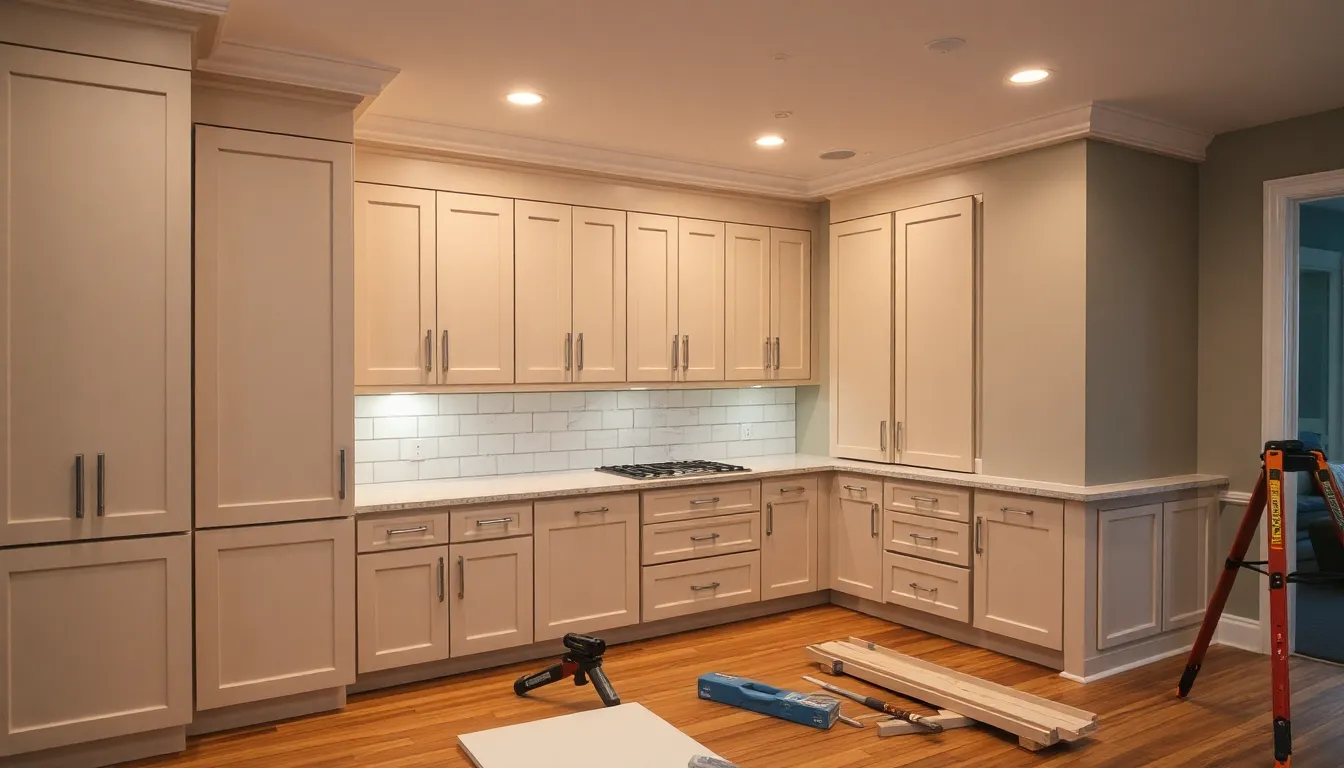
Every Salt Lake County homeowner with a 15-to-30-year-old two-story home knows the frustration of tiptoeing down an upstairs hallway at midnight only to trigger loud metallic pops and wood groans outside a sleeping child's bedroom. Along the high-desert Wasatch Front, winter indoor humidity routinely plunges below 18%, shrinking dimensional lumber joists, engineered wood I-joist flanges, and 23/32-inch OSB subfloor panels. Smooth-shank pneumatic framing nails driven hastily during original tract construction lose friction grip, allowing the OSB deck to slide up and down the steel nail shank by a millimeter with every footstep. Pulling old carpet gives you a once-in-20-years window to cure every squeak permanently.
Why Smooth Builder Framing Nails Fail in Utah's Dry Climate
During production framing in the 1990s and 2000s across South Jordan, Riverton, Lehi, and Layton, framing crews often tacked OSB subfloor sheets down in rain or snow using pneumatic 8d smooth-shank nails and cold-thickened subfloor glue that skinned over before sheets were dropped. Over three or four arid Wasatch heating seasons, framing lumber moisture content drops from 15% at rough-in down to 6% indoors, shrinking joist height slightly and breaking brittle adhesive beads. Once a nail hole wallows out slightly, every footstep rubs raw OSB resin vertically against smooth steel—acting exactly like a violin bow. Driving extra nails only repeats the failure; mechanical screw threads must clamp deck tightly to flange.
- Lumber shrinkage from 15% framing MC down to 6% winter MC loosens smooth pneumatic 8d subfloor nails
- Floating rigid-core LVP amplifies subfloor deflection squeaks far louder than thick carpet and pad ever did
- Once floating click-lock LVP is installed, you cannot drive screws from above without tearing up entire rooms
Stand-Up Collated Subfloor Screw Grid & Plumbing Safety Checks
Guessing where joists sit or driving random 3-inch drywall screws is a recipe for puncturing pressurized PEX water lines, hydronic radiant loops, or 120V Romex cables stapled near the top of floor joists. Before firing a single fastener, our crew maps original nail lines, verifies exact 16-inch, 19.2-inch, or 24-inch O.C. engineered wood I-joist flange widths, and inspects bathroom wet-wall bays with multi-depth scanners and borescope cameras. We then run stand-up Quik Drive collated screw guns loaded with Simpson Strong-Tie #8 x 1-3/4-inch or 2-inch WSV subfloor screws—whose unthreaded upper neck and aggressive deep threads cinch 23/32-inch OSB tightly against TJI flanges without protruding deep into utility cavities.
- #8 x 1-3/4-inch WSV dual-thread subfloor screws provide 25% higher withdrawal resistance than standard deck screws
- Fastener schedule places screws every 6 inches along panel seams and every 8 to 10 inches in field bays
- Brittle black drywall screws are strictly banned because hardened shanks snap under cyclic live-load shear
Relieving Binding Tongue-and-Groove Seams and Partition Wall Rubs
Roughly 20% of upstairs floor noises are not loose nail squeaks at all—they are wood-on-wood friction groans along desiccated OSB tongue-and-groove panel edges or beneath non-load-bearing bedroom partition bottom plates nailed between joists. After screwing every joist line tight across all bedrooms and hallways, our carpenters walk every square foot in heavy boots, heel-dropping across doorways, closets, and bed footprints to isolate stubborn rub points. Where two swollen or dry OSB edges grind together mid-span between joists, we make a controlled 18mm-deep relief kerf down the T&G seam using a depth-locked plunge track saw (stopping safely shy of joist flanges) and inject low-viscosity polyurethane construction adhesive into delaminated pockets.
- Depth-locked 18mm track-saw relief cuts stop dry OSB tongue-and-groove edges from grinding mid-span
- Angled structural screws secure loose interior partition bottom plates down into underlying blocking or joists
- Delaminated water-swollen OSB near upstairs laundry machines or tub aprons is cut out and re-blocked
Sanding Swollen OSB Seams Flat Before Laying Upstairs LVP
Countersinking 1,800 to 2,500 collated subfloor screws across an upstairs level pulls minor OSB lippage downward, yet older homes frequently still exhibit 1/8-inch peaked panel edges left over from framing weather exposure twenty years ago. Thick carpet padding hides minor edge swell easily, whereas rigid-core LVP bridges across raised OSB seams, creating hollow drum bounce and stressing click-lock end joints until tabs fracture. Immediately after our screw-down pass, we run a heavy walk-behind 16-inch rotary floor buffer fitted with 24-grit tungsten-carbide sanding screens over every OSB butt joint, vacuum clean with HEPA extractors, and feather low truss valleys with flexible cementitious patch so your new floor feels vault-solid.
- 24-grit rotary floor sanding shaves swollen OSB panel ridges dead-flush across hallway traffic lanes
- Every screw head is countersunk 1/32 inch below the OSB face so fastener burrs never dimple LVP backing
- Adds less than 4 to 6 hours to a multi-room flooring project while permanently protecting click-lock warranties
Upstairs Subfloor Squeak Remediation Methods & Salt Lake County Pricing
| Subfloor Repair Scope | Fastener & Structural Spec | Utah Cost Range | Effectiveness & Best Timing |
|---|---|---|---|
| Full Second-Story Screw-Down | Collated #8 x 1-3/4" WSV screws @ 6"/8" grid on chalked joists | $0.85 – $1.45 / sq ft | Eliminates 90%+ of nail squeaks; do during carpet tear-out |
| T&G Seam Relief + Glue Injection | Depth-locked kerf cuts + polyurethane elastomer seam fill | $1.35 – $2.10 / sq ft | Silences mid-span panel-rub groans between wide 24" TJIs |
| Localized OSB Panel Replacement | Cut out swollen deck, add 2x6 sister blocking + new 23/32" T&G | $225 – $475 per 4x8 sheet | Required around leaked upstairs toilets, tubs, or washers |
| Through-Carpet Snap-Off Screws | Breakaway scored screws driven blind through existing carpet | $175 – $350 spot service | Hit-or-miss stopgap; inferior to bare-deck full screw grid |
Grant Helmer's Utah Field Pro-Tip (DOPL #10146123-5501)
When we pull upstairs carpet on a West Jordan or Draper remodel (DOPL #10146123-5501), never let an installer rush straight to laying pad or LVP over bare builder nails. Spending $900 on a systematic collated WSV screw-down and seam sand while the OSB is wide open turns a noisy 1990s second floor into a whisper-quiet luxury level.
Frequently Asked Questions: Fix Squeaky Upstairs Floors Before Installing Lvp Carpet
Why shouldn't I use standard black drywall screws to fix squeaky subfloors?
Black phosphate drywall screws have thin, brittle hardened shanks engineered only to hold light gypsum board against stationary studs. Under dynamic footstep shear and seasonal Utah humidity shifts, drywall screw heads snap right off, leaving sharp broken shanks that squeak worse than the original framing nails.
Can driving subfloor screws accidentally hit plumbing pipes or electrical wires?
Yes—if an installer blindly drives overly long 2-1/2-inch or 3-inch screws. Because IRC code requires steel nail plates whenever pipes or wires pass within 1-1/4 inches of framing edges, using exact 1-3/4-inch subfloor screws over 23/32-inch OSB penetrates just 1 inch into the joist flange, staying safely above deeper utility runs.
Will screwing down the subfloor stop ceiling drywall nail pops on the main floor below?
We always inspect main-floor ceilings directly beneath heavily deflected hallways before tightening wide subfloor gaps. Gradually cinching loose OSB tight against TJI flanges dramatically reduces vertical joist bounce and prevents future ceiling tape cracks—while any wide 1/4-inch shim gap gets injected with structural urethane adhesive rather than slammed shut.
Can you fix squeaks under an existing hardwood or LVP floor from the basement below?
If the basement ceiling below is unfinished and open, we can silence main-floor squeaks from underneath without disturbing finished planks above by brushing carpenter's glue onto tapered pine shims tapped gently between joists and subfloor decking, or installing side-mounted aluminum joist-to-deck tension brackets with short 5/8-inch top screws.
Related Utah Roofing, Bathroom & Remodeling Resources
Schedule Your Salt Lake County & Wasatch Front, UT Inspection or Design Quote
Direct owner consultation with Grant Helmer (Utah DOPL #10146123-5501) — zero high-pressure sales.