
Baseboard Trim Upgrades With New Flooring: 5-Inch Craftsman Profiles

Upgrading builder baseboards to 4.5-inch or 5.5-inch square-edge Modern Craftsman trim during a flooring installation in Utah costs $4.75 to $8.50 per linear foot installed, caulked, puttied, and painted ($1,400 to $3,200 for a typical main level). Urban Design & Remodel (Utah DOPL #10146123-5501, (801) 440-1952) eliminates tacked-on quarter-round shoe molding and hides old drywall paint scars cleanly.
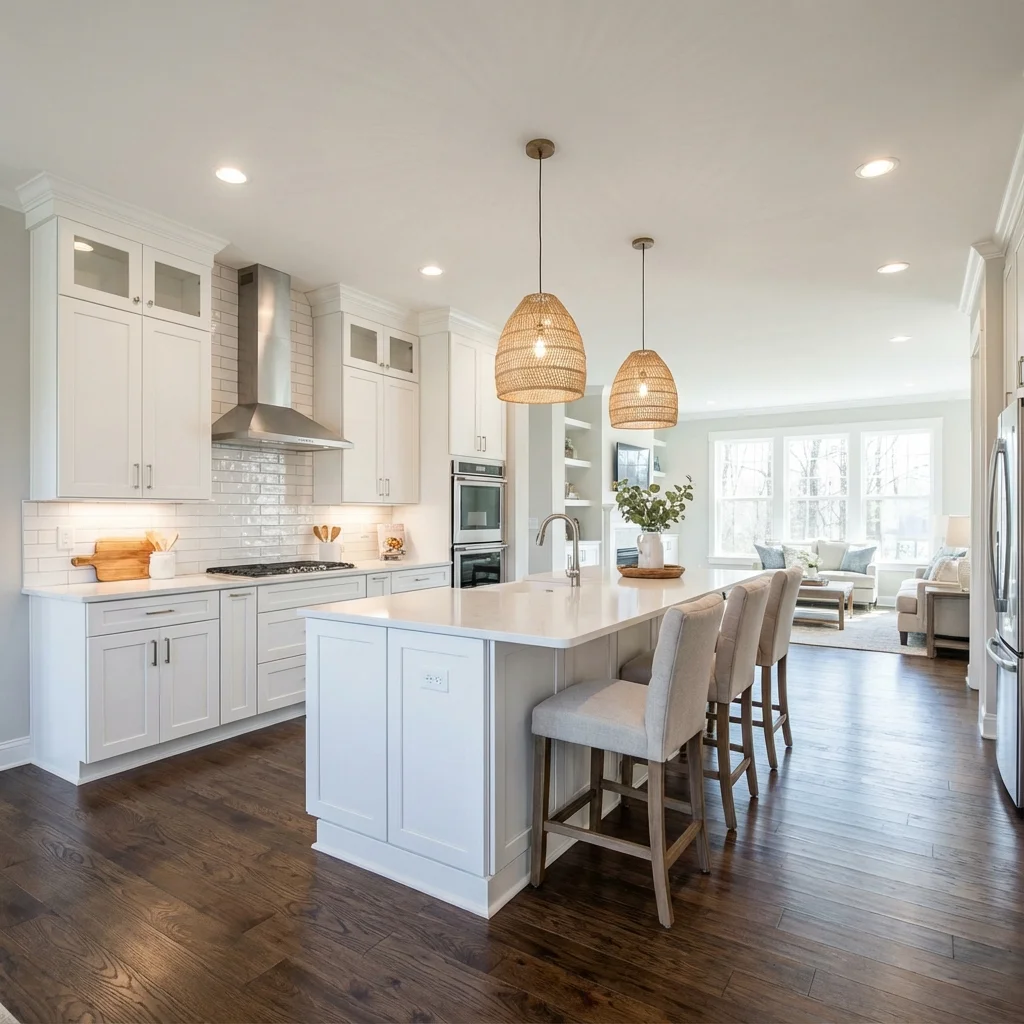
Nothing dates a brand-new $15,000 wide-plank LVP or engineered white oak floor faster than reinstalling beat-up 2-1/2-inch 1990s colonial scalloped baseboards—or worse, nailing bulky quarter-round shoe molding along the bottom because the old trim wasn't pulled first. When plush carpet and 1/2-inch pad come out of a Salt Lake County home and sleek 7mm LVP goes down, the finished floor elevation drops by nearly half an inch. Lowering old short baseboards to meet the new floor exposes an ugly, unpainted ridge of torn caulk and drywall texture along every wall in the house. Upgrading to taller 5-1/4-inch or 5-1/2-inch Craftsman baseboards solves geometry, aesthetics, and wall repair in a single pass.
Why Flooring Swaps Expose Old Caulk Scars & Force Shoe-Molding Shortcuts
Carpet installers originally set short 2-1/2-inch or 3-1/4-inch builder baseboards 1/2 inch up off the OSB subfloor so thick carpet edges could tuck neatly underneath. Once that carpet is replaced by low-profile rigid-core LVP or glue-down engineered hardwood, a gaping 1/2-inch shadow gap sits beneath the existing trim. Budget flooring crews attempt two flawed shortcuts: either they leave old baseboards nailed high and tack unpainted quarter-round shoe molding across the bottom (pushing bookcases out from walls and shouting 'cheap retrofit'), or they pry off old trim and drop it 1/2 inch—exposing torn drywall paper and decades of built-up wall paint ridges that demand costly drywall skimming and full-room repainting.
- Switching from carpet + pad (~3/4" thick) to LVP (~5/16" thick) drops finished floor height by ~7/16 inch
- Upgrading from 3-1/4" colonial trim to 5-1/4" or 5-1/2" flat stock completely covers old caulk and paint ridges
- Saves $1,500–$3,500 in drywall skim-coating and wall touch-up painting across open-concept great rooms
9/16-Inch Thick Trim Geometry: Hiding 1/4-Inch LVP Expansion Gaps Without Shoe
Floating click-lock LVP and engineered wood require an unobstructed 1/4-inch to 3/8-inch perimeter expansion gap around every room perimeter so planks can expand and contract across Utah's seasonal indoor thermal swings without buckling. Cheap big-box 3/8-inch-thick wafer baseboards barely cover a 3/8-inch expansion gap—especially where residential drywall hangs 1/2 inch above the bottom framing plate or bows inward slightly between wall studs. We supply and install true 9/16-inch or 5/8-inch thick square-edge or micro-bevel Modern Craftsman baseboards, providing generous coverage over perimeter flooring gaps with crisp vertical architectural shadow lines, clean vacuum clearance, and zero tacked-on quarter-round shoe molding anywhere.
- True 9/16-inch to 5/8-inch trim thickness easily bridges 3/8-inch LVP expansion gaps without shoe molding
- Baseboards are set 1/32 inch off the LVP face (never pinned down tight!) so floating floors slide freely
- Plinth blocks or cleanly matched thickness transitions integrate thicker 5.5-inch base against thinner door casings
MDF in Dry Rooms vs Cellular PVC or Pine in Wet Baths, Laundries & Mudrooms
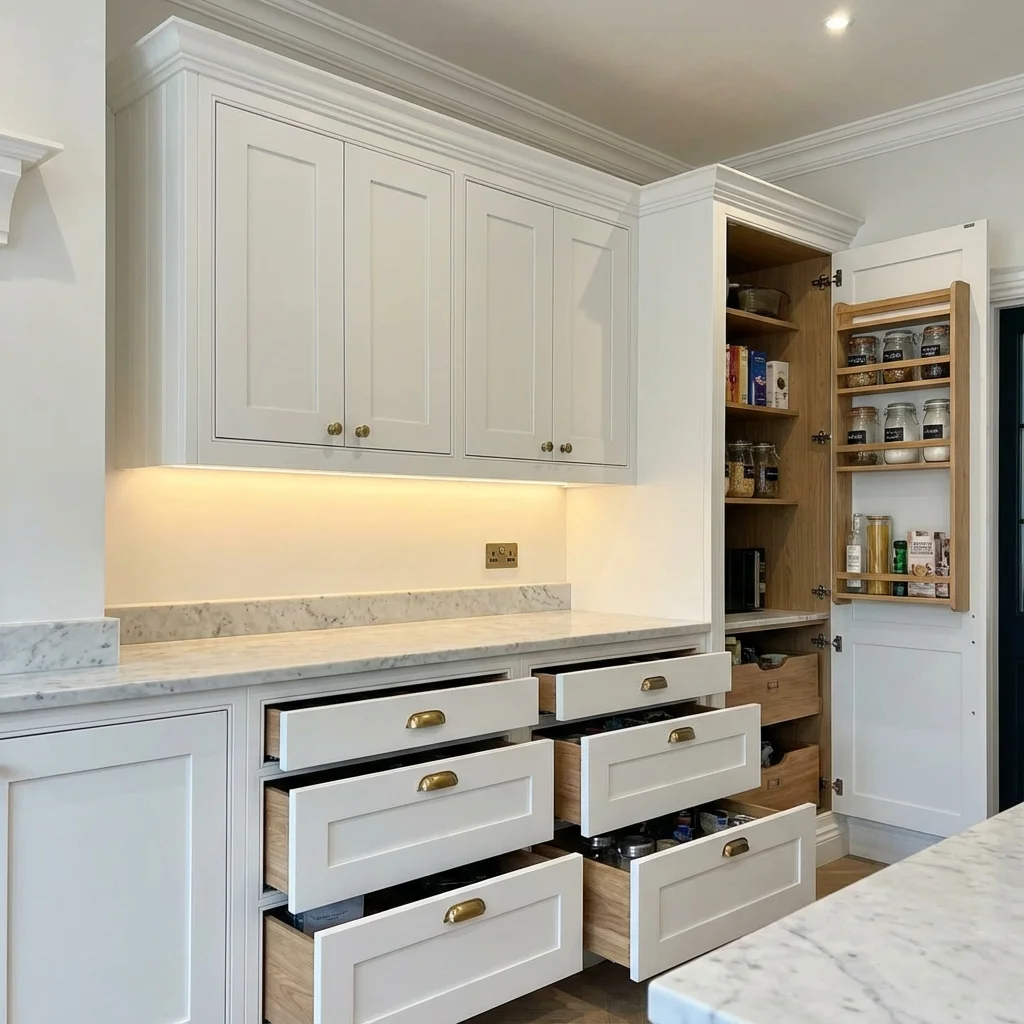
High-density primed MDF makes phenomenal baseboard material across dry Utah living rooms, hallways, and bedrooms because it arrives in straight, knot-free 16-foot lengths, accepts glass-smooth enamel paint, and resists warping in 15% winter humidity. However, raw MDF acts like compressed blotter paper the instant standing water touches its cut bottom edge—swelling irreversibly into fuzzy mushrooms beside shower curbs, toilets, dishwashers, and snowy mudroom entries. Our specification separates wet and dry zones automatically: we transition seamlessly into matching-profile 100% waterproof cellular PVC or primed solid finger-jointed radiata pine sealed on all six faces inside every bathroom, laundry room, kitchen sink wall, and garage mudroom.
- 16-foot knot-free MDF boards minimize mid-wall scarf joints along expansive open-concept living room walls
- Waterproof cellular PVC or primed solid pine protects bathroom toilet alcoves, tub fronts, and snowy mudrooms
- Bottom edges of wood baseboards near exterior sliders receive primer coat before fastening to block moisture wicking
Glued Outside Miters, Scarf Joints, and Scuff-Proof Enamel Finishing
In dry Wasatch Front homes, outside drywall corners wrapped in metal corner bead routinely measure 88 to 92 degrees rather than a textbook 90, causing standard 45-degree trim miters to yawn open within one winter. Our finish carpenters measure every corner angle with digital protractors, pre-assemble outside miters using two-part cyanoacrylate structural wood adhesive (2P-10) so joints stay locked permanently, scarf-cut mid-wall splices directly over wall studs using 15-gauge angled finish nails into the 2x4 bottom plate, and sand filled nail holes dead-flush. Stock receives sprayed cabinet-grade acrylic-alkyd semi-gloss or satin trim enamel before installation, followed by elastomeric top-edge caulking and a seamless final brush-and-roll topcoat.
- Two-part cyanoacrylate glued outside miters stay razor-sharp even through dry Utah winter framing movement
- 15-gauge angled finish nails anchor into 2x4 bottom plates every 16 inches—never into floating LVP planks
- Bottom trim-to-floor seam is left uncaulked on floating floors (except flexible 100% silicone in wet bathrooms)
Utah Baseboard Upgrade Options & Installed Cost Per Linear Foot
| Baseboard Profile & Material | Dimensions | Installed & Painted Cost | Ideal Room Application |
|---|---|---|---|
| Modern Square / Craftsman MDF | 9/16" x 5-1/4" or 5-1/2" | $4.75 – $6.75 / lin ft | Main-floor great rooms, halls, basements & bedrooms |
| Solid Finger-Jointed Primed Pine | 9/16" x 5-1/4" square/step | $6.25 – $8.50 / lin ft | Kitchen toe zones, mudrooms, kids' heavy-impact halls |
| 100% Waterproof Cellular PVC | 5/8" x 5-1/4" smooth matte | $7.50 – $10.25 / lin ft | Bathrooms, shower curb junctions & laundry rooms |
| Matching Door Casing Upgrade | 11/16" x 3-1/2" Craftsman | $135 – $215 per door side | Replaces dated 2-1/4" colonial casings to match 5.5" base |
Grant Helmer's Utah Field Pro-Tip (DOPL #10146123-5501)
Whenever a homeowner in Sandy or West Jordan asks how to make 5.5-inch baseboards meet existing thinner 2-1/4-inch colonial door casings cleanly (DOPL #10146123-5501), we add a tiny 22.5-degree chamfer return on the top front edge of the baseboard right where it butts the casing—eliminating awkward proud ledges without replacing every interior door frame.
Frequently Asked Questions: Replace Baseboards With New Lvp Flooring Cost
Should you caulk the bottom of baseboards to new LVP flooring?
No—in dry living areas, bedrooms, and kitchens, never caulk baseboards down to a floating LVP floor. Hard acrylic painter's caulk glues the plank face to the wall trim, pinning the floating floor and causing click-lock joints to separate or peak. Only wet bathrooms receive 100% flexible silicone along tub and toilet perimeters.
How many linear feet of baseboard does an average 1,200-square-foot main floor require?
Including reach-in closets, bedroom hallways, pantry alcoves, and a standard 10% miter-cut allowance, a typical 1,200-square-foot Salt Lake County main floor requires roughly 280 to 360 linear feet of baseboard trim—putting a complete 5.5-inch Modern Craftsman MDF upgrade between $1,450 and $2,400 caulked and painted.
Do you paint the new baseboards before or after installing them over new floors?
We do both: we spray or roll two smooth coats of scuff-resistant urethane-alkyd trim enamel onto the raw primed 16-foot lengths on sawhorses prior to installation, then putty nail holes, caulk the top drywall seam, mask the new floor, and apply a final seamless finish coat in place.
How do you score old baseboards off walls without tearing drywall paper above?
Before touching a flat pry bar, our carpenters slice deeply along the top caulk line using fresh razor utility blades angled downward, then tap wide glazing bars over stud locations with a drywall block behind the fulcrum so paint above the new 5.5-inch line stays completely intact.
Related Utah Roofing, Bathroom & Remodeling Resources
Schedule Your Salt Lake County & Wasatch Front, UT Inspection or Design Quote
Direct owner consultation with Grant Helmer (Utah DOPL #10146123-5501) — zero high-pressure sales.